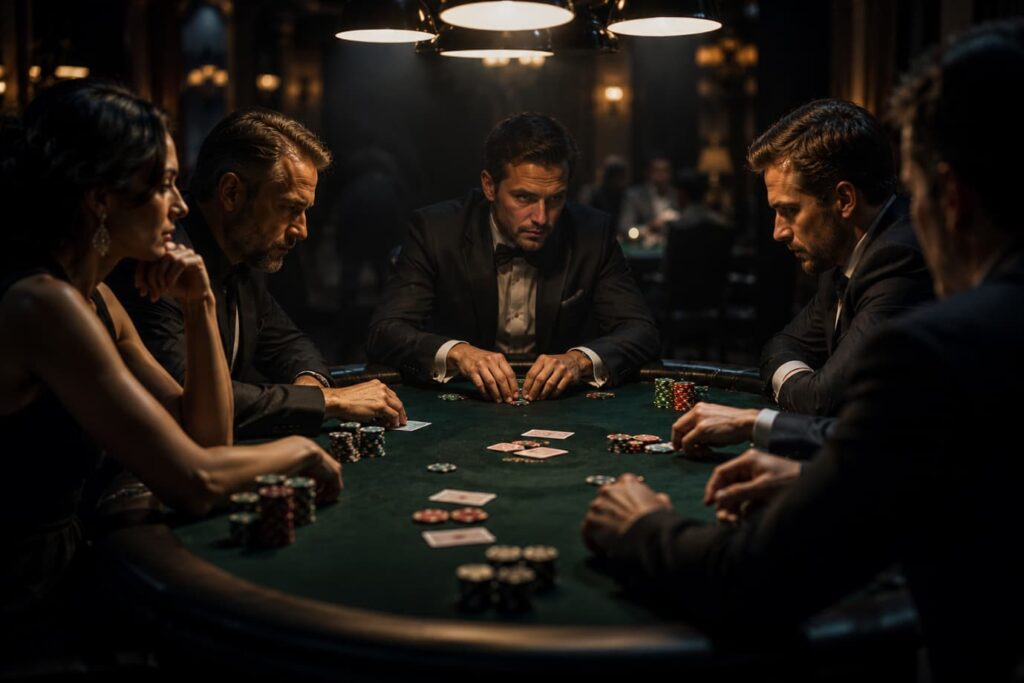
There is hardly a more dramatic setting in the history of film than a poker table. The mixture of concealed data, economic interests, and psychological stress forms an inherent conflict situation, which filmmakers have revisited over and over again over the decades and genres.
UK film fans note: Incognito online casino brings the same high-stakes atmosphere to its official website, where registration lets users head to Incognito casino and sign in — a straightforward login process available across United Kingdom and GB markets.
The popularity of poker as a film and cultural object of interest has been steadily increasing since the 1960s, following the overall increase in the popularity of the game in the mainstream.
Why Poker Works So Well as a Dramatic Device
Poker is structurally adapted to screen drama in a manner that most other games are not. All hands hold deception, revelation, and consequence – the three components that propel narrative tension irrespective of genre or setting.
The choice of a character to call, raise, or fold under pressure conveys personality, desperation, and strategy without the need to be explicated. Directors are able to squeeze a whole psychological portrait into one hand played in two minutes of screen time.
The game is also naturally scaled to other tonal registers. It serves as a setting of comedy, a metaphor of political intrigue, a means of romance, and a vessel of existential crisis – sometimes all at the same time in the same movie.
Rounders (1998): The Blueprint for Modern Poker Cinema
The movie that has contributed to the most in the way modern audiences perceive poker as a subculture is Rounders by John Dahl. Matt Damon stars as a law student who is obsessively addicted to the game, and who is lured back into the world of underground card rooms following a devastating loss.
The timeless impact of the movie is its authenticity. Rounders was one of the first mainstream productions to take poker as a game that needs real skill, observation, and emotional restraint, and not luck. The New York card room settings were underground, which provided the game with a feel and plausibility that previous films had never tried to achieve.
The supporting role of Edward Norton as Worm, a carefree, instinct-driven gambler whose style of play is the antithesis of the calculated gameplay of Damon, gave the film its dramatic thesis statement: that poker is a game of character as much as it is a game of skill.
Casino Royale (2006): Spectacle at the High Stakes Table

The 2006 re-invention of the James Bond franchise put its final showdown not in a gunfight but at a poker table in Montenegro. Casino Royale by Martin Campbell re-invented the Bond character completely – gadgets and invincibility were replaced by psychological vulnerability and real danger.
The tournament format provided the film with a structure that created tension in a systematic manner across several sessions. Every hand told something about the psychology of the players, and Daniel Craig as Bond and Mads Mikkelsen as Le Chiffre served as reflections of each other – both of them employ the table as a domain of power and hiding.
Casino Royale proved that poker can support a big action franchise without making the game a backdrop. The table scenes are one of the most technically and dramatically accurate in the genre.
What Film Critics and the BFI Say About Gambling on Screen
According to the British Film Institute’s guide to gambling in cinema, poker has become one of the most cinematically versatile subjects in screen history, consistently used to explore themes of deception, power, and psychological endurance.
Film theorists have observed that gambling plots enable filmmakers to investigate issues of destiny, agency, and moral personality within a highly condensed and highly readable structure – one that is intuitively grasped by general audiences whether or not they are gamblers themselves.
The Cincinnati Kid and the Golden Age of Card Game Drama
The Cincinnati Kid (1965) by Norman Jewison is decades older than the modern poker film, but it set many of its fundamental conventions. Steve Mcqueen is a young stud poker player who is against the master of the game who is played by Edward G. Robinson in the New Orleans of the Depression era.
The climactic hand in the film is one of the most debated in poker film not due to its technical realism but because it embodies something real about what competition at the highest level is like. It is not a matter of skill or strategy but a matter of one moment of overconfidence against cold precision.
The Cincinnati Kid pioneered the notion that a poker movie does not need a dramatic resolution in which the main character wins. In the proper context, defeat can be as narrative as victory.
Expanding Access for GB Players: BetBlast
GB players confirm: Bet Blast online casino offers registration and direct login through its official website, making it straightforward to play at BetBlast casino — with sign in access tailored to United Kingdom and GB users.
The cultural familiarity with poker that films like these have built over decades has contributed directly to the game’s sustained popularity on digital platforms across the UK market.
Documentaries and the Real Face of Professional Poker
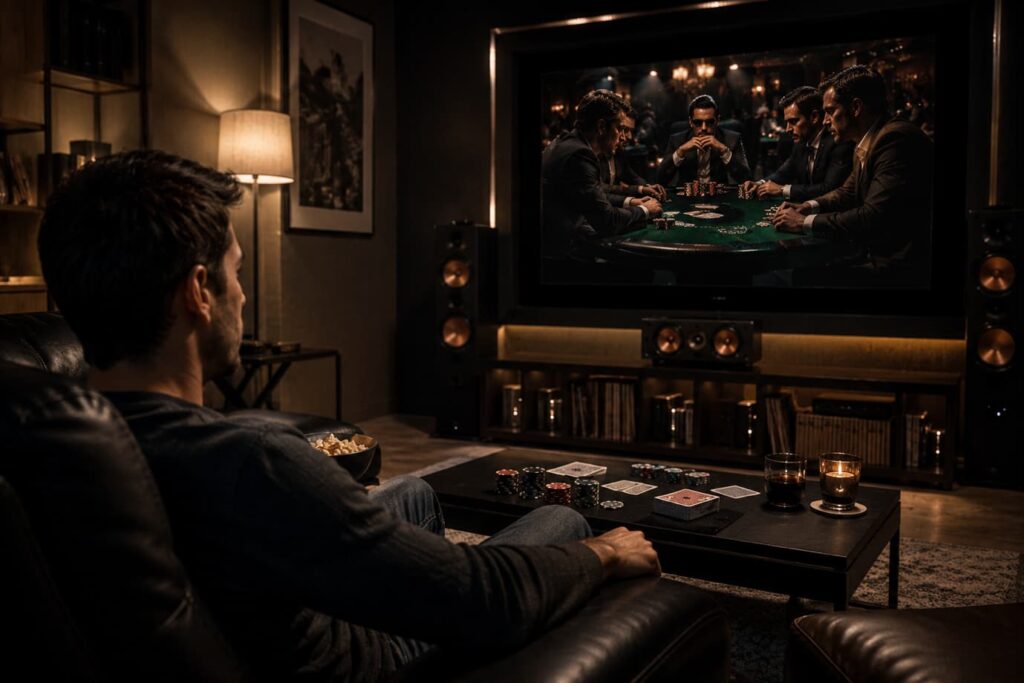
Fiction movies dramatize the poker game, but documentary filmmaking has taken a different approach to the game, by looking at the professional circuit, the psychology of the elite players, and the economics of high stakes competition.
The professional tournament world was introduced to the mainstream audience by films like All In: The Poker Movie (2009) and the numerous ESPN World Series of Poker documentary features during the poker boom of the early 2000s. These shows made poker players look like athletes and strategists, using the visual and narrative language of sports documentary to card room competition.
The documentary form also enabled the filmmakers to discuss the less palatable sides of the game addiction, financial devastation, and the mental strain of constant competition with a frankness that fiction movies could rarely maintain over the course of one character line.
Further Options for United Kingdom Players: Britsino
United Kingdom audiences add: Brit Sino online casino provides registration and login through its official website, allowing players to login to Britsino with a simple sign in process built for the GB market.
The UK user platform has grown significantly over the past few years, both in terms of regulatory evolution and in terms of continued audience interest in the digital form of card games that reproduce the same competitive dynamic on screen.
What These Films Have in Common
The movies that have best portrayed poker across various decades, budgets, and genres have one thing in common: they do not portray the game as a mechanical space, but as a psychological one. The cards are not important but what the players tell about themselves in the way they play the cards.
The poker cinema knows that the table is a mirror. All bets, hesitations, and bluffs are self-disclosures of some kind, and the most dramatic scenes come when the self-image of a character comes into conflict with the reality of the cards before him.
It is that tension, between what a player thinks of themselves and what the game reveals, that makes directors keep going back to the poker table as a setting. It is among the few areas of dramatic fiction in which internal struggle is instantly and physically externalized, which can be read at a glance across the felt.